
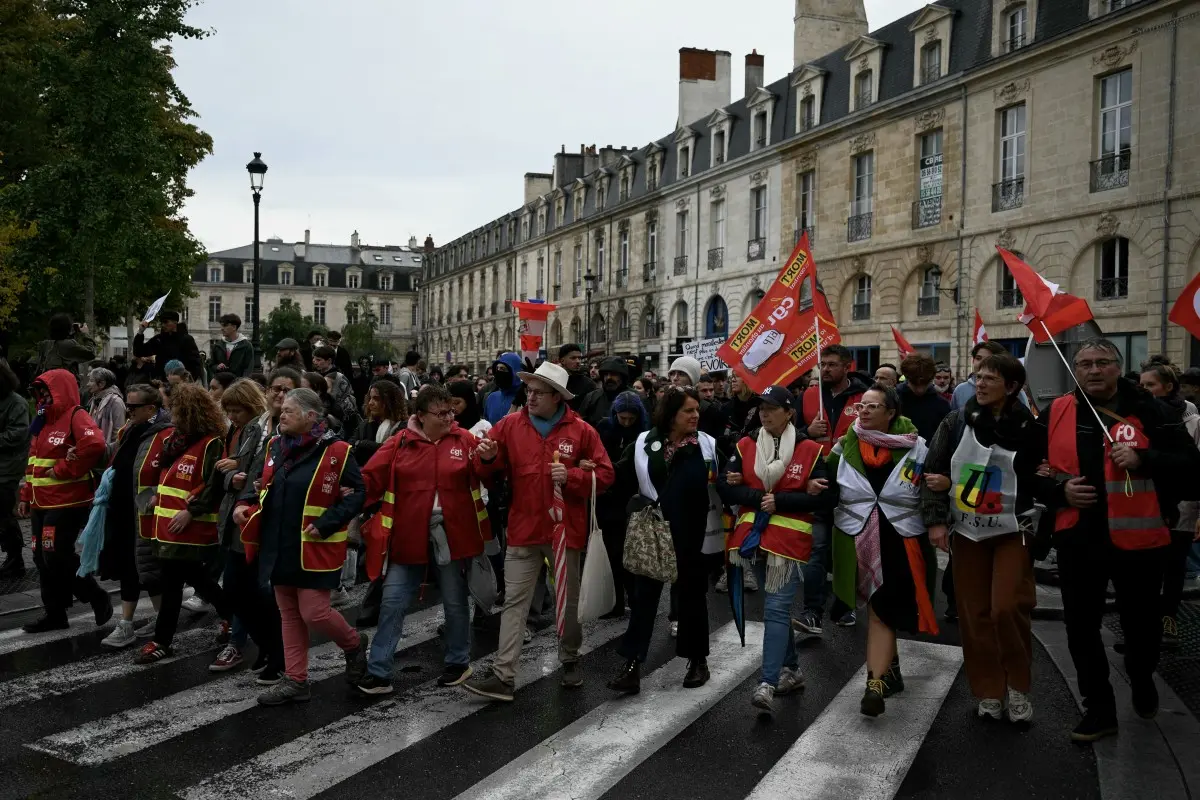
The strike has been called by the intersyndicale, a group that represents all of France's major unions - CFDT, CGT, FO, Unsa and FSU and is expected to affect sectors including public transport, education, healthcare and public administration, with unions from both the public and private sectors participating.
It comes after several weeks of protests over the rising cost of living, including three successive demonstrations organised on October 17th, 24th and 31st - although the strike had actually been planned before the sometimes-violent demos on October 17th.
The unions are calling for action on wages, public services, employment and industry, and have urged workers in both the public and private sectors, as well as young people and retirees, to join the strike and demonstrations. Their demands include higher wages, better purchasing power, the protection of public services and a fairer distribution of wealth.
Thursday will therefore see both strikes and marches, especially in the bigger towns.
France's hardline union CGT, has published a map on its website listing all the events planned for Thursday’s demonstrations. More than 100 events have so far been confirmed across France.
Carte générée par la CGT via carte.cgt.fr
Who will join the November 5th strike?
Unions representing railway workers, teachers, healthcare staff, postal and telecommunications workers and civil servants have all filed strike notices.
The Gilets Jaunes movement is separately calling for what it describes as a 'November 5th of the people' (5 novembre du peuple), with organisers hoping to bring together different groups involved in the recent protests.
Lycées students are also expected to take part in the demonstrations. Speaking to news outlet BFMTV, a representative of a youth organisation said that lycées students - aged 15 to 18 - and university students would join workers in the streets, “they supported us, so we are supporting them too.”
READ MORE: Do French schoolkids have the legal right to strike?
Which sectors could be affected?
The strike could have an impact across a wide range of industries, including public transport, schools, hospitals, banks, insurance companies and the medical sector.
Public transport - Railway and urban transport unions have called on their members to join the mobilisation, meaning services could be disrupted on Thursday.
France's railway company SNCF says that it expects minor disruption on the high-speed TGV services, but more disruption on regional lines including Intercité and TER routes. Anyone whose train is cancelled will be contacted and given a full refund.
Travellers should check their journeys before setting off, particularly if they are planning to take trains or use public transport in major cities.
In Paris the Metro, bus and tram network will run as normal, but there will be some disruption on the RER and Transilien suburban rail services. They are;
- RER A - normal
- RER B - Two thirds of normal services south of Gare du Nord, half of normal services north of Gare du Nord (including the connection to Charles De Gaulle airport)
- RER C - Half normal services
- RER D - One third of normal services
- RER E - Two thirds of normal services
- Ligne H - Half normal services
- Ligne J - Two thirds normal services
- Ligne K - Normal
- Ligne L - Two thirds normal services
- Ligne N - Half normal services
- Ligne P - Two thirds normal services between Meaux and La Ferté-Milon
- Ligne R - Half normal services
- Ligne U - Half normal services
- Ligne V - Normal
For long-distance travels, the SNCF expects “slightly disrupted” TGV services, while Intercités and TER trains (regional trains) are likely to be more heavily affected. Passengers who provided their contact details when booking their ticket will be notified by text message or email if their train is cancelled or changed.
The disruption is expected to be less severe than during the nationwide strike on June 10th, 2026, when one in three TGVs and one in two Intercités services were cancelled.
Education - On Wednesday, the education ministry said that 17 percent of teachers had given notice of their intention to strike, although there will likely be regional disparities. In nursery and primary schools, teachers must declare their intention to strike at least 48 hours in advance.
In secondary schools, teachers are not required to declare their intention to strike in advance, meaning the extent of disruption in collèges and lycées may only become clear on Thursday itself. The Snes-FSU, the main secondary education union, has called for widespread participation.
Public services and healthcare - Civil servants, including employees of local authorities, central government and public hospitals, are also being called to strike.
Hospitals, administrative offices and school canteens could therefore experience disruption, although the extent will depend on how many employees participate.
The same applies to other services, including postal services and telecommunications.
Doctors and pharmacists are also among the professions whose unions have called for participation.
Emergency healthcare is not affected, but routine or pre-planned appointments or clinics may be disrupted or rescheduled.
Post and phone - employees of La Poste will join the strike, which could result in disruption to postal deliveries on Thursday as well as the closure of post offices in some areas.
Staff at the mobile phone and internet companies SFR and Orange have also filed strike notices - this won't affect phone or internet connections, but could mean that offices are closed or support staff not available.
Paris
As well as strike action, Paris will also be the location for the largest march on Thursday.
READ ALSO: MAP: Route for the Paris demo on November 5th
Metro stations may be temporarily closed depending on the protest route, particularly those near major gathering points or along the march. Some roads may be closed to traffic or subject to restrictions while demonstrations are taking place. Make sure to check Citymapper or Google Maps on the day of the protest for updates.
The mobilisation could also affect the Vélib' bike-sharing service, which may temporarily close certain stations, particularly around demonstration routes. During the last two Saturdays of protests, Vélib' closed 110 stations and removed bikes to prevent them from being used in barricades or damaged during protests, at the request of the police.
The Vélib' app will show which stations will be affected.
What happens after Thursday?
For now, most unions have not officially called for the strike to continue beyond November 5th. But the FSU union has suggested that a single day of action may not be enough to achieve the unions' demands.
The Gilets Jaunes coordination group has already called for an 'Act IV' of the demonstrations, with further strikes, protests and blockades planned for November 6th and 7th.
READ ALSO: Calendar: The strikes, demos and blockades planned in France this week
Follow the latest protest-related news in our protest section here.
Comments